






Our websites offer information mostly for educational purposes with no intent to alter health care protocols nor to serve as a sole source of medical information.
Always seek the advice of your local health care provider.
|
× UKRAINIAN CHILDREN WITH DISABILITIES HAVE SPECIAL NEEDS |
HEAD
Ahead Heading Headache
Cephalic Cephalon Cephalea Encephalitis Cap Cup Capitol Capitalist
Skull Scale Skeleton Sclerosis Migraine
To illuminate CAPital ideas regarding HEAD and to avoid a MIGRAINE, HEADache, or CEPHalea, it is prudent to do go AHEAD and CAP this task, as outlined in the CAPtion, in three CAPital ChAPters (CAPitulo in Spanish).
Comments about ideas in HEAD or CAPITA, CAP, CUP, CEP, and CEPhalon are given under "Related" below.

CEPHALIC (head first) birth or delivery of a new being to face the light.
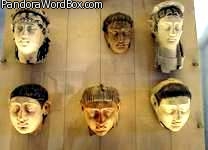
CAPitalistic CAPtains may fail to realize that the CAPacity of their CAPita (head) is not bigger than that of their ancient ancestors.
Note that some people with a limited CAPacity or inCAPacity to learn may be called "CABbage heads", an expression also found in Ukrainian where cabbage is "CAPusta" and "pusto" means empty.
There are multiple notions in CAPita, CAPtious, CAPitols, CAPitals, CAPitalists, CAPtains and so on. In a manner of speaking, all of these terms convey a sense of scope or content as in CAPacity which brings us to CUP. Notably, CAP and CUP imply "hard" as in CHARa (goblet), CHEREP (skull) and CHEREPakha (turtle, an animal shielded by a hard shell or CAParazon in Spanish). In fact, CUPS, HEADS or SKULLS are HARD like a SCALE or SKALA (rock in Ukrainian) and serve as shields to protect the brain or CEREBRUM. The CEREBRUM is as soft as CEREAL or the CERUMEN (ear wax) and as tender as the Goddess CERES. Another similitude of SKULL and SKALA is with SCALE, SCLERA, SCLEROSIS, the idea being "dry", which points to SKELETON, which formerly meant "dried up" remnants of a corpse.
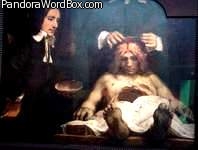
An anatomist is holding the cup-like CAP of the CAPut of the cranial vault, while another is dissecting the meninges.
SKOAL reminds us of Vikings who used a SKULL as a CHALICE or drinking CUP to make CHARming toasts. Note that in Ukraine (a country where Vikings settled) CHEREP, CHARa, and CHARiVna also denote SKULL, CHALICE, and CHARming.
Head size or the CAPacity of the CRANium may or may not correlate with CEREBRAL functions. In some persons, the skull is small (microCRANia or microCEPHaly), while in others it is large (macroCRANia or megaloCEPHaly). If extreme, MicroCEPHaly and macroCEPHALy are associated with cerebral and intellectual dysfunctions.

Allegoric choice of "still" object (except for the candle which is a symbol of time).
The shape of the SKULL CRANIUM or CALVarium may be altered by a disharmonious or disorderly closure or abnormal fusion of cranial sutures, which should remain patent as long as the CEREBRUM is growing. At times, some or all cranial sutures may fuse prematurely and cause CALVaria to become sharply pointed (oxy), long (acro), toll like a tower (turri), or crooked as if plagiarized (plagio) - these are roots that, when combined with "cephaly", give rise to the many "combo" or complex medical terms included under "Related" below or in the Word Rooster.

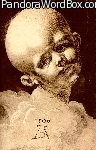
Normal infants and children's skulls have unused cranial sutures and open fontanelles (window or fontana or fountain like gaps); the child on the right has macrocephaly, and his cranial sutures are probably widened.
Among extreme cephalic anomalies are anenCEPHaly (no head) and hydroCEPHaly or "water in the cranium" or "water head", a common complication of spina bifida (unfused spine). Spina bifida may also be described as meningomyelocele or meningocele to denote exposed or herniated meninges and spinal cord tissues. Collectively, birth defects represent failures of "neural tube" development (NTD). Currently, the prevention of NTDs is simple and affordable ... but thousands of children continue to be born with NTDs ... many children die, and those who survive, most often are paralized for life ... mothers and women who daily consume tablets containing 400 micrograms of synthetic folic acid (a vitamin B) reduce their chances by nearly 70% of having a child birth with NTD ... in fact, all women and men of any age should consume 400 micrograms of synthetic folic acid every day ... those who do so reduce their chances of suffering from strokes (hemiplegia), heart attacks (myocardial infarctions), some forms of cancer, and perhaps Alzheimer's syndrome, a type of cerebral SCLERosis.
Expanded vistas of CALVarium emanate from Spanish CALVo for BALD. Notably, the CUPola of the scalp or CABeza (head) is like a CAPella. In older males, the CALVarium is often bereft of hair or CABello (scalp hair). This should remind us of mount CALVary or CALVario. In either case, these words convey ideas of desolation or barrenness. Indeed, the top of the SKULL or CRANial vault, often is like a BALD CUP or CUPOLA. Some scientists sustain that the loss of scalp hair is due to anomalies of CAPillaries or hair thin vessels.
Finally, we get to GLABELLA, or the foreHEAD or METOPIC, which in humans is BALD or hair free.
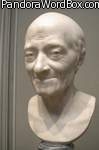

Two famous bold and bald men who were aHEAD of their times
and had prominent foreHEADS or glabellas as well as seminal forethoughts.
